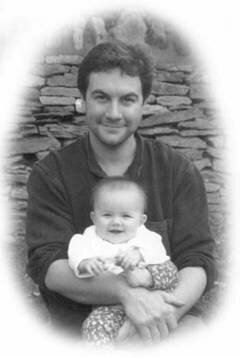
 Hello. I am David Bainbridge and I write popular science books, usually about biology. My aim is to write books that can explain to anyone how we as humans actually work.
Contrary to popular belief, science is essentially simple. Unlike most areas of human endeavour, our scientific knowledge has accumulated as a series of simple incremental steps. Because of this, it can all be explained as a simple story, so long as you leave out all the awful jargon.
Although I now work at Cambridge University, I used to work as a veterinary surgeon and I soon realised that you can explain biology to anyone as long as you see it from their point of view.
Also, biology can be more interesting than most people expect. Obviously, it has the power to tell us what we are and how we got here, but the story of how we acquired that knowledge is itself fascinating. The history of biology is populated by an array of wonderful, awful, charming, irritating, strange, imperfect people who got it wrong more often than they got it right.
And sometimes getting it wrong is more interesting. Most of all it has shown us that although humans represent just one of millions of animal species, we are the weirdest and most fascinating species on earth. And only by understanding that weirdness can we understand why humans do the things we do, and why being human feels like it does.
I love a blank page and the opportunities it gives. A chance to weave words into a narrative of what we know and why we know it. I like to base my books on questions which non-specialists ask me – no one asks more interesting questions.
And most of all, I like to tell stories.
About the books
I have written six books so far – one about the brain, one about X chromosomes, one about pregnancy, one about teenagers, one about middle age, and now one about female curves.
To find out more about any of the books – synopsis, reviews, purchasing details and translations available – just click below.
Curvology: the Origins and Power of Female Body Shape
Paleontology: An Illustrated History
Stripped Bare: The Art of Animal Anatomy
How Zoologists Organize Things: The Art of Classification
Beyond the Zonules of Zinn: A Fantastic Journey Through Your Brain
X in Sex: How the X Chromosome Controls Our Lives
A Visitor Within: The Science of Pregnancy (Making Babies in the US)
Some more about me
I have a day job. I am the University Clinical Veterinary Anatomist at what we like to think of as the best science university in the world: Cambridge University. A member of the Department of Physiology, Development and Neuroscience, I am responsible for organising and teaching many of the pre-clinical veterinary courses at the university. Our aim is to use our understanding of evolutionary and developmental biology to inform our teaching of animal structure and function. If you are interested in studying Veterinary Medicine at Cambridge, then click this link and this link.
Many staff at Cambridge are also affiliated to one of the thirty-or-so colleges – small communities of teachers, researchers and students studying a wide range of science, arts and social science subjects. The collegiate system gives all of us a unique level of intellectual and social stimulation and support.
Most of my popular science output is published as books, but there are some exceptions to this.
I live in Suffolk with my wife Michelle and three children, Eleanor, Edward and Rose.
And a little more about me.